Deforestation in Kelantan: 1990-2020 Satellite Imagery Uncovers Environmental Threat in Malaysia

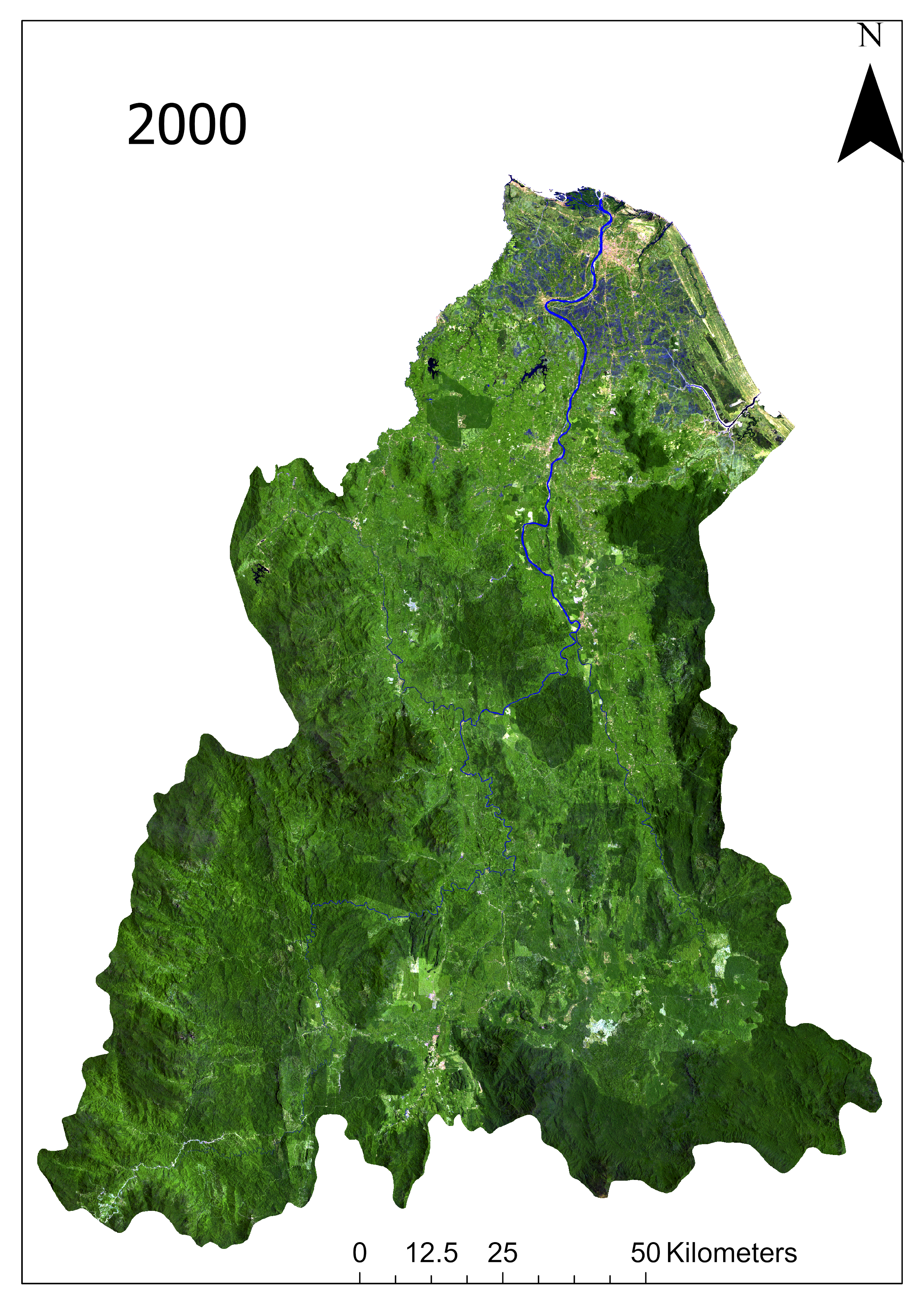
Figure 1- Satellite imagery of Kelantan from 1990 to 2020, displayed in false colour SWIR bands.

Large deforestation trends for the past 30 years

Figure 2- Kelantan, Malaysia

Green indicates areas where forest cover change is little to none, while white and purple indicate increasing levels of forest cover change(Figure 3). Deforestation has been most prominent in the eastern and central district of Kelantan, where PFR and ESA level-1 area logging restrictions have been ignored. Northern regions consist mainly of developed urban areas.

Figure 3- RMSE values of linear regression of raster DN values based on satellite imagery from 1990 to 2020 at 5-year intervals
Can you log in reserves?

The National Forestry Act 1984 requires all State Forestry Departments to manage and protect Permanent Forest Reserves or Estates(PFR), sustainably for timber products(Figure 4). To extract timber from PFRs, logging operators must obtain a valid license, which is subject to environmental impact assessment reports per the Environmental Quality Act 1974 and the approval of State Forestry Departments. Logging is prohibited in National Parks. State land forests are subject to the State government’s purview and they are not protected by the National Forestry Act 1984.

Figure 4- Permanent Forest Reserves, National Parks, and State Lands in Kelantan
Can you log in environmentally sensitive areas?

Environmentally sensitive areas(ESAs) are classified into three different priority levels based on indicators for disaster risk, life support values, and heritage values of a site(Figure 5). Malaysia’s Third National Physical Plan prohibits all forms of development for areas classified as ESA Level-1. ESA Level-2 areas allow limited deforestation while ESA Level-3 areas allow for industrial development under strict environmental regulations(TCPD, 2015).

Figure 5- Environmentally Sensitive Areas(ESA) in Kelantan

Future projections if we protect protected areas

Immediately stopping deforestation AND facilitating re-forestation is the best course of action for our environment. Using geospatial analysis, three scenarios for 2025 are projected to anticipate immediate action by the Kelantan government to protect our remaining forests.

  1. No deforestation in PFRs only(Figure 6)
  2. No deforestation in PFRs and ESA Level-1 only(Figure 7)
  3. Business-as-usual(Figure 8)

By manipulating the spectral reflectance values of the trend map, re-forestation in protected areas are simulated either by allowing natural regrowth or active replanting along the edges of remaining intact forests. Scenario 1 and 2 showed increasing patches of green within delineated PFR and ESA Level-1 areas, but not sufficient to regain significant forest cover in the eastern district. The business-as-usual scenario showed continued deforestation along the edges of remnant forest patches. Even in the best possible scenario where all applicable policies are in force, deforestation is very difficult to be reversed in PFRs and ESA Level-1 areas in the near-term. Active decision-making must be taken to revoke controversial logging licenses and re-forest logged areas.

Figure 6(top)- No deforestation in PFRs only by 2025
Figure 7(center)- No deforestation in PFRs and ESA Level-1 by 2025
Figure 8(bottom)- Business-as-usual deforestation by 2025

Methods

Landsat 8 OLI/TRS and Landsat 5 ETM Surface Reflectance imagery of Kelantan is collected from Google Earth Engine(Gorelick et al., 2017). Images taken within the years 1990, 1995, 2000, 2005, 2010, 2015, and 2020 are combined and corrected for cloud cover and atmospheric distortions. All images have a 30m spatial resolution. PFR and ESA maps are extracted from Malaysia’s Third National Physical Plan dated in 2015(TCPD, 2015) and geo-processed as clipping polygons.

32-bit shortwave infrared(SWIR) bands(Band 7 for Landsat 5 and 8) are extracted and geo-processed into a multidimensional raster. The SWIR band is found to be excellent at distinguishing forests from other land use classes and is even able to distinguish between tree species(Ferreira et al., 2019). Based on spectral profile analysis of an image of Kelantan in 2020, primary forests, plantations, water bodies, and bare soil/urban areas can be clearly distinguished based on the SWIR band(Figure 1). Increasing raster digital number(DN) values of a pixel indicate change from primary forest to developed land uses.

The generate trend raster function from ArcGIS Pro(Esri Inc., 2021) is used to run a linear regression for the pixel values in the map. Results of the regression show very small R2 values(mean R2=0.01249, p=0.7691, where p<0.05), which can be interpreted as an equivalent of no change in trends. Root mean square error(RMSE) for the DN values(mean=338.0) is used instead as an indicator of how much the pixel values deviate from having no change(Figure 4).

The predict using the trend raster function and the raster calculator from ArcGIS Pro(Esri Inc., 2021) is used for the scenario projections. A default projection raster for the year 2025 is created based on the trend raster and is used for the scenario calculations. For scenario 1(Figure 5), DN values more than 250 within PFR areas are deducted by 50 to simulate natural regrowth and reforestation efforts. For scenario 2(Figure 6), DN values more than 250 within PFR and ESA Level-1 areas are deducted by 50. For scenario 3(Figure 7), DN values between 300-400 are increased by 50 disregarding delineations of either PFR or ESA Level-1. Pixels that occur within the 300-400 range mostly occur in remnant or isolated patches near the edges of remaining forests, therefore they represent forest edge logging. The values chosen for the calculations are derived from observations of the trend raster results.

Limitations

The accuracy of satellite imagery is limited by the patches of distortions and null values created by the cloud cover removal function form GEE. The metric used to identify primary forest conversion assumes plantations and bare soil have different tree cover density compared to primary forests. The linear trend over 30 years oversimplified and failed to account for plantation regrowth and harvesting seasons that can occur for several cycles within a 5-year interval. Scenario projection criteria and assumptions are subjective based on observations on results and therefore should be validated by further ground testing. Projections solely based on raster value changes over 30 years fail to capture the human dynamics of logging concessions and licensing operations that cannot be explained by assuming logging only ensues around forest edges.

____

Bryan Yong,
University of Nottingham Malaysia
23rd March 2021

1004 words

References

C4 Center (2016) An Insight into the Kelantan Logging Industry. Available at: https://www.cfourconsultanciessdnbhd.com/main/c4center.org/insight-kelantan-timber-industry.html.

Environmental Quality Act 1974(Malaysia) (2006). Putrajaya: Attorney General’s Chambers of Malaysia. Available at: http://www.agc.gov.my/agcportal/uploads/files/Publications/LOM/EN/Act 127.pdf.

Esri Inc. (2021) ArcGIS Pro (Version2.7.1), Esri Inc. Available at: https://www.esri.com/en-us/arcgis/products/arcgis-pro/overview.

Ferreira, M. P. et al. (2019) ‘Tree species classification in tropical forests using visible to shortwave infrared WorldView-3 images and texture analysis’, ISPRS Journal of Photogrammetry and Remote Sensing, 149, pp. 119–131. doi: https://doi.org/10.1016/j.isprsjprs.2019.01.019.

Gorelick, N. et al. (2017) ‘Google Earth Engine: Planetary-scale geospatial analysis for everyone’, Remote Sensing of Environment, 202, pp. 18–27. doi: https://doi.org/10.1016/j.rse.2017.06.031.

National Forestry Act 1984(Malaysia) (2006). Putrajaya: Attorney General’s Chambers of Malaysia. Available at: http://www.agc.gov.my/agcportal/uploads/files/Publications/LOM/EN/Act 313.pdf.

TCPD (2015) National Physical Plan 3(translated from Bahasa Malaysia). Kuala Lumpur. Available at: https://www.melaka.gov.my/ms/koleksi-media/penerbitan/lain-lain/lampiran-ll/rancangan-fizikal-negara-ke-3-rfn3.

The Missing ‘HUM’

Traveller’s Album Showcase-Pulau Ketam and Kuala Selangor (31/3/2019).

The blood cockle (Andara granosa) is a bivalve shellfish that is known for its red ‘bloody’ appearance due to the presence of haemoglobin – the same thing we have in our blood – in their body fluids. In Chinese, cockles are called ‘see hum’.

Cockles are Important in Malaysia

Source: (Dof.gov.my, 2019; Fao.org, 2019; Lim, 2014)

However, the cockle trade is threatened

Production down

Once the largest blood cockle producer in the world, the industry is on the brink of collapse. Data from Tridge shows Malaysia’s blood cockle production declining 78.5% for the past 5 years. Now its contribution to global production is 4th in place at 3.4%, nothing compared to China supplying 74.1% globally(Tridge, 2019).

Graph of year v. cockle production in wholesale value/RM and tonnes. Source: (Dof.gov.my, 2019)

Data from the Department of Fisheries show that cockle production has been on a steady decline since, despite the increase in cockle production from 2007 to its peak in 2010 due to the Selangor government’s cockle aquaculture initiative. 2016 sees the worst harvest. Coincidentally an El Niño year, no cockle spawn was available and cockle production plummeted in that year. We can also see inflation in the cockle price, as the wholesale value of cockles does not decrease in parallel with cockle production in tonnes.

Cockle trade threatened. Source: https://www.thestar.com.my/news/nation/2016/05/17/cockle-trade-threatened-production-down-to-16000-tonnes-from-100000-tonnes/

Price flux

My latest market visit in April sees prices of frozen de-shelled cockles at RM12.50/800g, whereas RM9.90/ kg for fresh cockles. Pulau Ketam has no blood cockle supply. When asking around the fish market, they’ve charged for RM12.00/kg and and will only supply upon request. In the 1980s, cockles were sold at 60 cents per kilogram. In 2007, it was RM1 per kilogram. Now, its sold RM8-13 per kilogram.

Fresh and frozen cockles in the supermarket.
Cockle prices rise. Source: https://www.nst.com.my/news/nation/2017/10/290899/production-plummeting-cockles-no-longer-cheap-seafood-indulgence

Pollution and dying

Pollution and habitat disturbance are the main reasons causing the decline in cockle production. Chemical effluents from river sources, disruptions in rainfall, runoff and tidal flows, and poor fishing habits are to blame for the dwindling populations and slowed growth rates of the cockles.

Mind map of the causes and effects of pollution and habitat disturbance on the cockle production. Source: (Buntal, 2019; Cemacs.usm.my, 2018; Yurimoto et al., 2014)

Where is the trade?

Habitat

Blood cockles are an inter-tidal species, meaning they live in areas of silty soil, such as mud flats and mangrove estuaries with alternating periods of submersion and exposure every day. They are filter feeders and live only very shallow beneath the coast (1 inch). Gathering cockles is possible either from natural or cultural beds (Fao.org, 2019).

Distribution of blood cockles are mainly around South East Asia and Northern Australia

Spawning is most active during rainy season. Cockle babies are swept off shore by increasing river inflow and return to the shore along the flow during the dry seasons. Reproductive season is between late raining season and early dry season of January and March in the west coast. Most spat are reproduced and harvested during this period. Cockle spat usually spawn once a year, which depends entirely on the water quality.

Aquaculture

In order to have an in-depth view of the cockle aquaculture industry , I’ve managed to meet up with the very same cockle farmer that is interviewed in the news and scientific studies – Mr. Kahar Buntal. He is a bright man in his 60s with a warm smile and a wealth of stories.

Source: (Buntal, 2019; Selangor Cockle Culture Project, 2019; Lim, 2014)

“Cockle aquaculture is a tough job despite no feeding or maintenance of the land plot is required. Workers need to watch guard of the farm day and night on boat patrols, from the dangers of cockle spat thieves and smugglers.”

Selangor spat is the best in quality. 1 tin of spat costs RM500-600. Usually two tins costing RM1000 are used for 150 acres. 1 tin weighing 1 kg has about 30000 spats. During harvesting, 1 kg will consist of 100 adult cockles and is sold at market price.

Border Control Agency (AKSEM) in Kedah arrested 2 men and seized 100kg of spats worth RM500,000 believed to be smuggled to Thailand. Young cockles fetch a price of RM500/kg if demands are high. Source: https://www.thestar.com.my/news/nation/2019/02/05/foiled-attempt-to-smuggle-cockles-into-thailand/

Working for 1-2 hours in the morning will get you 10-15 sacks of cockles each weighing 70kg. an estimate of 25% dead harvest are then sorted out. This amount is already less than what Kahar said when interviewed in 2012 (Lim, 2014).

This is less lucrative than fisheries. In fact, many cockle farmers in Kuala Selangor no longer invest in the industry, instead they transition into restaurant owners that are more lucrative.

Is the use of this resource sustainable?

Blood cockles are a sustainable resource for these reasons.

  • Cockle aquaculture diversifies traditional fishermen’s income, particularly in the cockle-producing west coast states of Peninsular Malaysia.
  • Cockles are filter feeders, they help eat up decaying matter in the ocean floor, improving the water quality of inter-tidal and estuarine ecosystems.
  • As bio-indicators, their presence indicates a healthy ecosystem.
  • Cockle aquaculture does no damage to the landscape.
  • Since they are the naturally dominating population in mudflats, large scale introduction of cockles in the environment does not cause fatal food chain disturbances.

What can we do to save the ‘hum’?

When asked, Kahar voice was very distraught and desperate:

“MNS came on 29/3/2019 to check on the pollution, they just shook their heads helplessly, as nothing can be done to repair the damage done.”

Buntal Kahar, 2019

Kahar has voiced out on many news media, including TV3 and numerous newspapers. Moreover, studies by JIRCA and UM were done, but all to no avail. Before leaving, I was given a task and a plea to uncover the worsening situation that is pollution that may one day rob Kahar and his family of their main income.

Pollution is the major cause for production loss, which then causes overharvesting and smuggling. The hard work behind the tasty shellfish deters many young people from the industry.

We must take up responsibility to clean up the ocean and encourage young people to work in cockle aquaculture. Any sightings of pollution must also be reported. Action must be taken from all sides and by everyone to save our missing ‘hum’.

Picture This Festival 2018 – Picture This Festival 2018 – Malaysia Finalist Short Film <<Mr. Garbage>>. The video features a fisherman turned electrician that dedicates his work to clean up Pulau Ketam’s pollution. Source: https://www.youtube.com/watch?v=aRmS9oLWhZM

Recent clean-up efforts in Pulau Ketam.

References

Cemacs.usm.my. (2018). Why cockles are becoming costlier and harder to find. [online] Available at: https://cemacs.usm.my/index.php/ms/15-aktiviti/95-why-cockles-are-becoming-costlier-and-harder-to-find.

Fao.org. (2019). FAO Fisheries & Aquaculture – Aquatic species. [online] Available at: http://www.fao.org/fishery/species/3503/en.

Dof.gov.my. (2019). Annual Fisheries Statistics 2006-2017. [online] Available at: https://www.dof.gov.my/index.php/pages/view/82.

Buntal, K. (2019). On the Cockle Industry.

Lim, C. (2014). Our blood cockles are dying. Can we stop the killing? – Environment | The Star Online. [online] Thestar.com.my. Available at: https://www.thestar.com.my/news/environment/2014/08/11/our-blood-cockles-are-dying-can-we-stop-the-killing/.

Selangor Cockle Culture Project. (2019). Portal Rasmi Jabatan Perikanan Malaysia. [online] Available at: https://www.dof.gov.my/index.php/pages/view/1763.

Tridge. (2019). Cockle global production and top producing countries – Tridge. [online] Available at: https://www.tridge.com/intelligences/blood-cockle1/production.

Yurimoto, T., Mohd Kassim, F., Fuseya, R. and Man, A. (2014). Mass mortality event of the blood cockle, Anadara granosa, in aquaculture ground along Selangor coast, Peninsular Malaysia. International Aquatic Research, 6(4), pp.177-186.

Design a site like this with WordPress.com
Get started